Radiation and Electromagnetic Radiation
The Electromagnetic Spectrum
The electromagnetic (EM) spectrum is the range of all types of EM radiation. Radiation is energy that travels and spreads out as it goes – the visible light that comes from a lamp in your house and the radio waves that come from a radio station are two types of electromagnetic radiation. The other types of EM radiation that make up the electromagnetic spectrum are microwaves, infrared light, ultraviolet light, X-rays and gamma-rays.
You know more about the electromagnetic spectrum than you may think. The image below shows where you might encounter each portion of the EM spectrum in your day-to-day life.
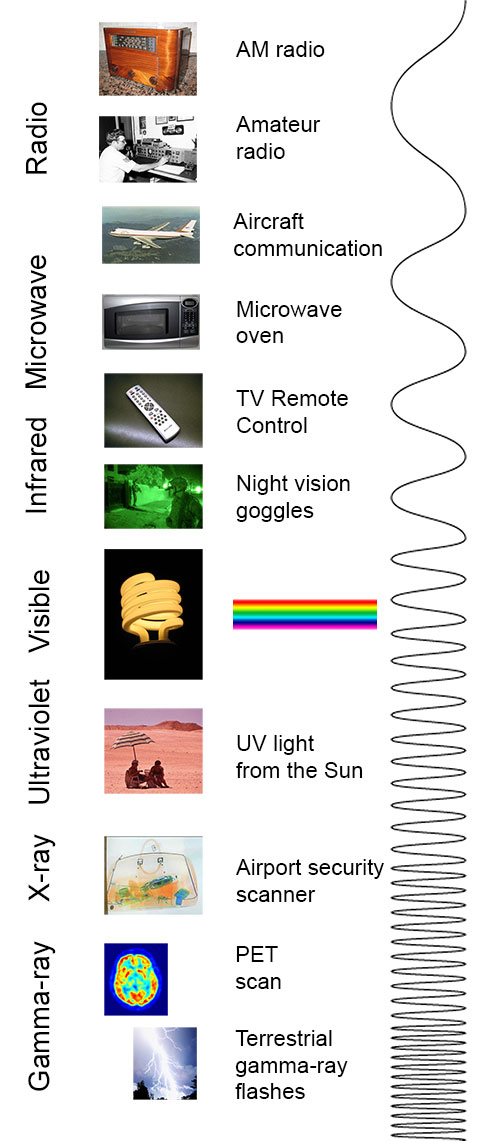
The electromagnetic spectrum from lowest energy/longest wavelength (at the top) to highest energy/shortest wavelength (at the bottom). (Credit: NASA's Imagine the Universe)
Radio: Your radio captures radio waves emitted by radio stations, bringing your favorite tunes. Radio waves are also emitted by stars and gases in space.
Microwave: Microwave radiation will cook your popcorn in just a few minutes, but is also used by astronomers to learn about the structure of nearby galaxies.
Infrared: Night vision goggles pick up the infrared light emitted by our skin and objects with heat. In space, infrared light helps us map the dust between stars.
Visible: Our eyes detect visible light. Fireflies, light bulbs, and stars all emit visible light.
Ultraviolet: Ultraviolet radiation is emitted by the Sun and are the reason skin tans and burns. "Hot" objects in space emit UV radiation as well.
X-ray: A dentist uses X-rays to image your teeth, and airport security uses them to see through your bag. Hot gases in the Universe also emit X-rays.
Gamma ray: Doctors use gamma-ray imaging to see inside your body. The biggest gamma-ray generator of all is the Universe.
Is a radio wave the same as a gamma ray?
Are radio waves completely different physical objects than gamma-rays? They are produced in different processes and are detected in different ways, but they are not fundamentally different. Radio waves, gamma-rays, visible light, and all the other parts of the electromagnetic spectrum are electromagnetic radiation.
Electromagnetic radiation can be described in terms of a stream of mass-less particles, called photons, each traveling in a wave-like pattern at the speed of light. Each photon contains a certain amount of energy. The different types of radiation are defined by the the amount of energy found in the photons. Radio waves have photons with low energies, microwave photons have a little more energy than radio waves, infrared photons have still more, then visible, ultraviolet, X-rays, and, the most energetic of all, gamma-rays.
Measuring electromagnetic radiation
Electromagnetic radiation can be expressed in terms of energy, wavelength, or frequency. Frequency is measured in cycles per second, or Hertz. Wavelength is measured in meters. Energy is measured in electron volts. Each of these three quantities for describing EM radiation are related to each other in a precise mathematical way. But why have three ways of describing things, each with a different set of physical units?
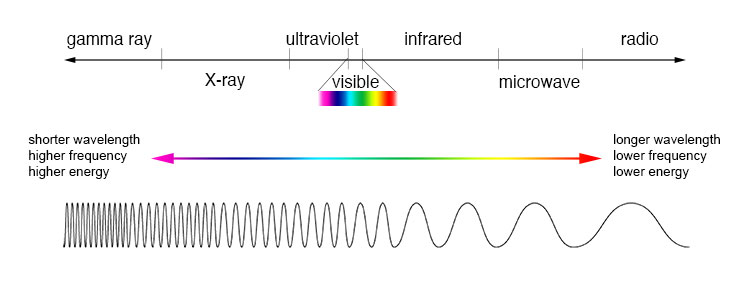
Comparison of wavelength, frequency and energy for the electromagnetic spectrum. (Credit: NASA's Imagine the Universe)
The short answer is that scientists don't like to use numbers any bigger or smaller than they have to. It is much easier to say or write "two kilometers" than "two thousand meters." Generally, scientists use whatever units are easiest for the type of EM radiation they work with.
Astronomers who study radio waves tend to use wavelengths or frequencies. Most of the radio part of the EM spectrum falls in the range from about 1 cm to 1 km, which is 30 gigahertz (GHz) to 300 kilohertz (kHz) in frequencies. The radio is a very broad part of the EM spectrum.
Infrared and optical astronomers generally use wavelength. Infrared astronomers use microns (millionths of a meter) for wavelengths, so their part of the EM spectrum falls in the range of 1 to 100 microns. Optical astronomers use both angstroms (0.00000001 cm, or
The wavelengths of ultraviolet, X-ray, and gamma-ray regions of the EM spectrum are very small. Instead of using wavelengths, astronomers that study these portions of the EM spectrum usually refer to these photons by their energies, measured in electron volts (eV). Ultraviolet radiation falls in the range from a few electron volts to about 100 eV. X-ray photons have energies in the range 100 eV to 100,000 eV (or 100 keV). Gamma-rays then are all the photons with energies greater than 100 keV.
 Show me a chart of the wavelength, frequency, and energy regimes of the spectrum
Why do we put telescopes in orbit?
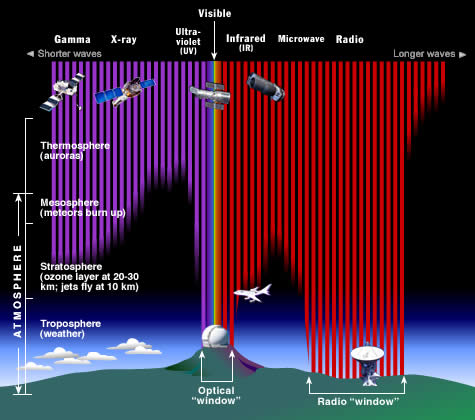
The Earth's atmosphere stops most types of electromagnetic radiation from space from reaching Earth's surface. This illustration shows how far into the atmosphere different parts of the EM spectrum can go before being absorbed. Only portions of radio and visible light reach the surface. (Credit: STScI/JHU/NASA)
Most electromagnetic radiation from space is unable to reach the surface of the Earth. Radio frequencies, visible light and some ultraviolet light makes it to sea level. Astronomers can observe some infrared wavelengths by putting telescopes on mountain tops. Balloon experiments can reach 35 km above the surface and can operate for months. Rocket flights can take instruments all the way above the Earth's atmosphere, but only for a few minutes before they fall back to Earth.
The Electromagnetic Spectrum
The electromagnetic (EM) spectrum is the range of all types of EM radiation. Radiation is energy that travels and spreads out as it goes – the visible light that comes from a lamp in your house and the radio waves that come from a radio station are two types of electromagnetic radiation. The other types of EM radiation that make up the electromagnetic spectrum are microwaves, infrared light, ultraviolet light, X-rays and gamma-rays.
You know more about the electromagnetic spectrum than you may think. The image below shows where you might encounter each portion of the EM spectrum in your day-to-day life.
The electromagnetic spectrum from lowest energy/longest wavelength (at the top) to highest energy/shortest wavelength (at the bottom). (Credit: NASA's Imagine the Universe)
Radio: Your radio captures radio waves emitted by radio stations, bringing your favorite tunes. Radio waves are also emitted by stars and gases in space.
Microwave: Microwave radiation will cook your popcorn in just a few minutes, but is also used by astronomers to learn about the structure of nearby galaxies.
Infrared: Night vision goggles pick up the infrared light emitted by our skin and objects with heat. In space, infrared light helps us map the dust between stars.
Visible: Our eyes detect visible light. Fireflies, light bulbs, and stars all emit visible light.
Ultraviolet: Ultraviolet radiation is emitted by the Sun and are the reason skin tans and burns. "Hot" objects in space emit UV radiation as well.
X-ray: A dentist uses X-rays to image your teeth, and airport security uses them to see through your bag. Hot gases in the Universe also emit X-rays.
Gamma ray: Doctors use gamma-ray imaging to see inside your body. The biggest gamma-ray generator of all is the Universe.
Is a radio wave the same as a gamma ray?
Are radio waves completely different physical objects than gamma-rays? They are produced in different processes and are detected in different ways, but they are not fundamentally different. Radio waves, gamma-rays, visible light, and all the other parts of the electromagnetic spectrum are electromagnetic radiation.
Electromagnetic radiation can be described in terms of a stream of mass-less particles, called photons, each traveling in a wave-like pattern at the speed of light. Each photon contains a certain amount of energy. The different types of radiation are defined by the the amount of energy found in the photons. Radio waves have photons with low energies, microwave photons have a little more energy than radio waves, infrared photons have still more, then visible, ultraviolet, X-rays, and, the most energetic of all, gamma-rays.
Measuring electromagnetic radiation
Electromagnetic radiation can be expressed in terms of energy, wavelength, or frequency. Frequency is measured in cycles per second, or Hertz. Wavelength is measured in meters. Energy is measured in electron volts. Each of these three quantities for describing EM radiation are related to each other in a precise mathematical way. But why have three ways of describing things, each with a different set of physical units?
Comparison of wavelength, frequency and energy for the electromagnetic spectrum. (Credit: NASA's Imagine the Universe)
The short answer is that scientists don't like to use numbers any bigger or smaller than they have to. It is much easier to say or write "two kilometers" than "two thousand meters." Generally, scientists use whatever units are easiest for the type of EM radiation they work with.
Astronomers who study radio waves tend to use wavelengths or frequencies. Most of the radio part of the EM spectrum falls in the range from about 1 cm to 1 km, which is 30 gigahertz (GHz) to 300 kilohertz (kHz) in frequencies. The radio is a very broad part of the EM spectrum.
Infrared and optical astronomers generally use wavelength. Infrared astronomers use microns (millionths of a meter) for wavelengths, so their part of the EM spectrum falls in the range of 1 to 100 microns. Optical astronomers use both angstroms (0.00000001 cm, or
The wavelengths of ultraviolet, X-ray, and gamma-ray regions of the EM spectrum are very small. Instead of using wavelengths, astronomers that study these portions of the EM spectrum usually refer to these photons by their energies, measured in electron volts (eV). Ultraviolet radiation falls in the range from a few electron volts to about 100 eV. X-ray photons have energies in the range 100 eV to 100,000 eV (or 100 keV). Gamma-rays then are all the photons with energies greater than 100 keV.
Show me a chart of the wavelength, frequency, and energy regimes of the spectrum
Why do we put telescopes in orbit?
The Earth's atmosphere stops most types of electromagnetic radiation from space from reaching Earth's surface. This illustration shows how far into the atmosphere different parts of the EM spectrum can go before being absorbed. Only portions of radio and visible light reach the surface. (Credit: STScI/JHU/NASA)
Most electromagnetic radiation from space is unable to reach the surface of the Earth. Radio frequencies, visible light and some ultraviolet light makes it to sea level. Astronomers can observe some infrared wavelengths by putting telescopes on mountain tops. Balloon experiments can reach 35 km above the surface and can operate for months. Rocket flights can take instruments all the way above the Earth's atmosphere, but only for a few minutes before they fall back to Earth.
Electromagnetic waves are emitted by many natural and man-made sources and play an important part in our lives. We are warmed by the electromagnetic emissions of the sun and we see using the part of the electromagnetic spectrum that our eyes detect as visible light. Electromagnetic (EM) radiation is a self-propagating wave in space or through transparent matter. EM radiation has an electric and magnetic field component which oscillate in phase perpendicular to each other and to the direction of energy propagation.
Electromagnetic radiation includes radio waves, microwaves, terahertz radiation, infrared radiation, visible light, ultraviolet radiation, x rays and gamma rays. The electromagnetic spectrum extends from below the frequencies of radio waves at the long-wavelength end through gamma radiation at the short wavelength end.
Human body is exposed to different kinds of EM radiation that includes the natural radioactivity in the earth, cosmic rays from outer space and also man made radiations coming from electric and electronic instruments. Diagnostic X ray machine, television sets, computers, microwave oven, radar devices, laser devices, mobile phones etc, generates radiations of different frequencies which exists in our environment as electronic smog.
Electromagnetic Spectrum

Sources of E.M.F
- Power Lines
An enormous amount of electricity is created at power generating stations and sent across the country through wires that carry high voltages. All power lines radiate electromagnetic fields. - Transformer
EMFs near a transformer can be quite high, but due to its small structure, the field strength diminishes rapidly with distance, as it does from any point source. - Home Wiring
Loop wiring in the home may create large e.m.f - Computers
Computers are a complicated subject. Know this: EMFs radiate from all sides of the computer. Thus, you must not only be concerned with sitting in front of the monitor but also if you are sitting near a computer or if a computer is operating in a nearby room. - Electric Blankets and Water beds
Electric blankets create a magnetic field that penetrates about 6-7 inches into the body. - Electric Clocks
Electric clocks have a very high magnetic field, as much as 5 to 10 mG up to three feet away. If you are using a bedside clock, you are probably sleeping in an EMF equivalent to that of a power line - Fluorescent Lights
Fluorescent lights produce much more EMFs than incandescent bulbs. A typical fluorescent lamp has readings of 160 to 200 mg 1 inch away. - Microwave Ovens and Radar
Microwave ovens and radar from military installations and airports emit two types of radiation–microwave and ELF. - Telephones and Answering Machines
Telephones can emit surprisingly strong EMFs, especially from the handset. This is a problem because we hold the telephone so close to our head. - Electric Razors and Hair Dryers
Electric razors and hair dryers emit EMFs as high as 200 to 400 mG.
Computer – The source of Pulsed Electromagnetic Radiation
When you sit in front of a computer or television, you are being bombarded by harmful waves quietly emanating from it. Even if you turn off the device, your biomagnetic field is still bombarded 24 hours a day, 7 days a week by the EM radiations from power cables, electric and electronic instruments. Extremely low frequencies waves (ELF) exist wherever electricity flows and radiate it from every electrical item in your environment. ELF radiation, the most underrated of the electromagnetic spectrum, deserves evaluation.
CRT (Cathode Ray Tube) based computer monitors use a beam of electrons accelerated by high voltage to generate image on the fluorescent screen. X rays may be produced when electrons are accelerated by high voltage, and strikes an obstacle in vacuum. In CRT based monitors, the image is formed by shooting a stream of electrons on the back of the screen, scanning back and forth across the screen, one line at a time. These electrons cause the screen to light up to produce the picture. Some of the energy from the electron beam escapes in the form of radiations at various frequencies particularly in the VLF (Very Low Frequency) and ELF (Extremely Low Frequency) bands.
The spot of electrons which sweeps the screen generates PEMR (Pulsed Electromagnetic Radiation) which at close range, disturbs the balance of all living cells. It has been established that, the harmful effects of PEMR exists all around the screen, especially in front and behind the monitor. The PEMR persists several hours even after the computer is switched off. Most people know that sitting too close to the screen increases the danger of radiation. But many do not realize that the sides and rear of the monitor are more dangerous. This means that even if you stay at two feet safe distance away from the screen, you may get radiation from the sides or rear of another computer terminal.
Computer Vision Syndrome (CVS)
If you use a CRT based computer for many hours, some ill effects like eyestrain and fatigue may develop which is known as Computer Vision Syndrome. This is mainly due to pulsed electromagnetic radiation and artificial light from the monitor. The same thing happens if you watch TV for long time. The CRT monitor uses fast beam of electrons that generates pulsed electromagnetic radiation carrying energy. At close range, this energy disturbs the metabolism and electrical activities of living cells.
Artificial fluorescent light from the monitor is the form of fractioned light which leaves out many segments of the spectral range. Flickering of the screen is also dangerous since the flickering rate is higher than the ‘Flicker-Fusion’ rate of the human eye. CVS is also caused due to bad contrast or excessively or poorly illuminated screen. Background illumination, posture, positioning of the monitor, ocular conditions like dry eyes and uncorrected refractive errors etc, increases the risk of CVS. Close watching reduces the muscle movements of the eyes and causes strain and fatigue.
To reduce the effects of CVS, many safety measures are recommended. The first and most important rule is to keep a safe distance of 14 inches from the screen although 24 inches preferred. More than 24 inches distance is necessary from the sides and rear of a near by monitor. It is important to note that Laptop computers using Liquid Crystal Display (LCD) are completely safe since there is no X ray emission from the screen.
Ways to protect from harmful radiations
Several problems have been observed in people who spend more than four hours a day in close proximity to an unprotected video terminal that uses a CRT based monitor. Stress, headaches, irritability, insomnia, eye strain, abnormal general fatigue, decrease in natural immunity, hormonal disturbances, disorders in the menstrual cycle are some of the ill effects of radiations.
Even more disturbing fact is that, exposure to radiation for long periods reduces spermatogenesis as observed in experimental animals. As the principle of precaution says “Faced with the risk of serious and irreversible damage, we cannot wait until we have all the scientific evidences before taking precautionary measures”. “Absence of certainty must not delay action”. Then what can we do? We can do something to protect ourselves.
- Don’t sleep under an electric blanket or on a water bed. If you insist on using these, unplug them before going to bed (don’t just turn it off). Even though there is no magnetic field when they are turned off, there may still be a high electric field.
- Don’t sit too close to your TV set. Distance yourself at least 6 feet away.
- Rearrange your office and home area so that you are not exposed to EMFs from the sides/backs of electric appliances and computers. In the home, it is best that all major electrical appliances, such as computers, TVs, refrigerators etc, be placed up against outside walls. That way you are not creating an EMF field in the adjoining room.
- Don’t sit too close to your computer. Computer monitors vary greatly in the strength of their EMFs, so you should check yours with a meter.
- Don’t stand close to your microwave oven. Move all electrical appliances at least 6 feet from your bed. Eliminate wires running under your bed. Eliminate dimmers and 3-way switches.
- Unplug all electrical devices which are not using.
- Get rid of microwave oven. It uses heat generating radiations for cooking. If the appliance is not well protected, microwaves will leak out.
- Avoid using watches with radium dial.
- Remove computer and TV from bedroom. During sleep, normal detoxification process takes place in the liver which may be blocked by the electromagnetic stress. Electromagnetic radiations from wiring cables, CRT monitors, Mobile phones etc, impinge on the pineal gland of brain suppressing its melatonin hormone. This hormone is important to regulate our biological cycles including sleep.
- Do not use computers or TV in children’s room. Children are more susceptible to the harmful effects of EMFs
- Do not keep mobile phones close to you while sleeping. Its emissions can alter your sleep physiology.
- Do not give mobile phones to children.


Comments
Post a Comment